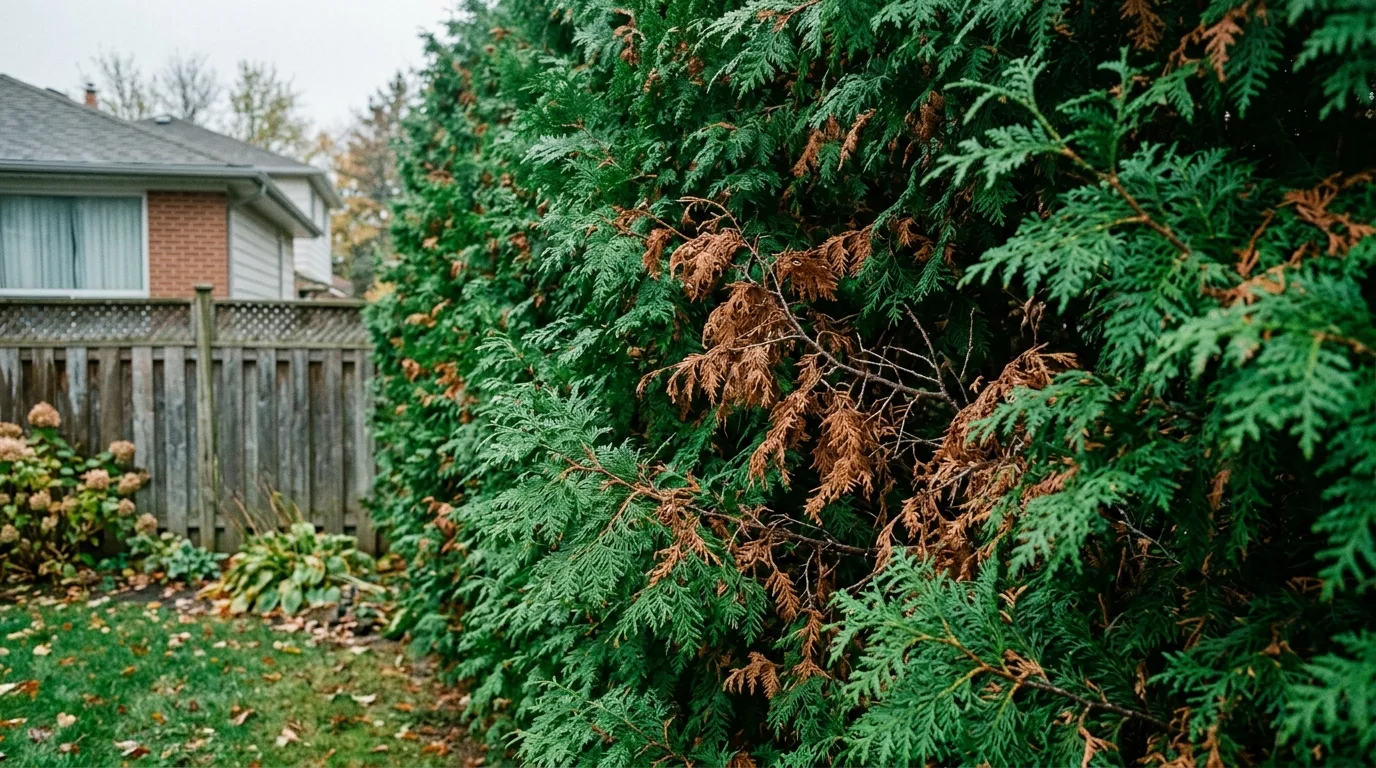
Cedar hedge browning is the most common call we get that is not a tree coming down.
Good news first. Brown cedar is often fixable, and it is rarely a disease. Bad news: cedar does not regrow from bare wood, so whatever browns out and dies stays bare. The goal is stopping the spread, not repairing what has already gone.
Where the brown is tells you most of what you need to know.
Brown at the bottom, green on top
Almost always water, and almost always the hedge competing with itself.
Cedars planted 60cm apart are fighting over the same soil. The upper growth wins because it gets the light, the lower growth gets shaded out and starved, and the bottom metre thins and browns from the inside out.
Essex County clay makes this worse than it would be in sandier ground. Our soil holds water hard when wet and then sets like concrete when it dries. Roots in compacted clay sit in a small volume of soil and cannot chase moisture sideways. A three-week dry stretch in July hits a clay-bound hedge much harder than the same stretch would hit one in loam.
What helps
Water deeply and slowly at the base rather than sprinkling the foliage. Mulch the root run so the surface does not bake. Thin the upper growth so light reaches lower down, which is a pruning job and easy to get wrong.
Brown on one side only, usually the road side
That is salt.
Half the hedges in this county are planted along a driveway, a sidewalk, or a county road, and they take a winter of road salt spray. Cedar hates it. You get brown or bronze foliage on the exposed face, sharpest at the height the spray reaches, and it shows up in late winter and early spring rather than in summer.
There is no cure once it has burned. You can rinse the foliage in early spring, water heavily to flush salt through the root zone, and put up a burlap screen on the road side over winter. If the hedge is on a county road that gets heavily salted, the honest answer is that cedar was the wrong plant for that spot.
Brown tips and edges all over, appearing in late summer
Drought stress, and it is the standard Windsor-Essex summer story. We get real heat and real dry stretches here, more than most of Ontario, and cedar has shallow roots that give up early.
Newly planted hedges are the most vulnerable. A cedar planted last spring has almost no root system and needs water at least weekly through its first two summers, whatever the weather did.
Brown sections with a hard straight edge
Look at the cut line. If the brown starts exactly where somebody trimmed, that is the trim.
Cedar has a hard rule: it will not push new growth from old bare wood. If a hedge gets cut back past the green foliage into the woody interior, that section stays brown permanently. Every year.
This is why hedge trimming is worth doing properly, and why the cheapest quote is often the expensive one. A crew working fast with a hedge trimmer set too deep can permanently disfigure twenty years of growth in an afternoon. We have been called to hedges in LaSalle and Tecumseh where the previous trim took it back to wood on one whole face, and there is genuinely nothing anyone can do except replace those plants.
Trim little and often. Stay in the green. Our cedar hedge trimming service works to that rule.
Brown in scattered patches with fine webbing
Spider mites or bagworm. Mite damage comes with fine webbing and stippled foliage, and you will see them if you hold a white sheet of paper under a branch and tap it.
Less common than the other four causes, but it is the one where a treatment actually helps.
When the hedge is past saving
Sometimes it is. If more than about half the hedge is bare, or the brown runs floor to ceiling on multiple plants, patching does not work. The replacements sit in the gaps looking like replacements for a decade.
At that point you are choosing between living with it and taking the row out to start over. Removal and stump grinding on a cedar row is straightforward work. If you are replanting, this is a good moment to reconsider whether cedar suits the spot at all. On a salted road frontage, it does not.
Get somebody to look at it
Brown cedar is usually diagnosable in about ten minutes standing in front of it.
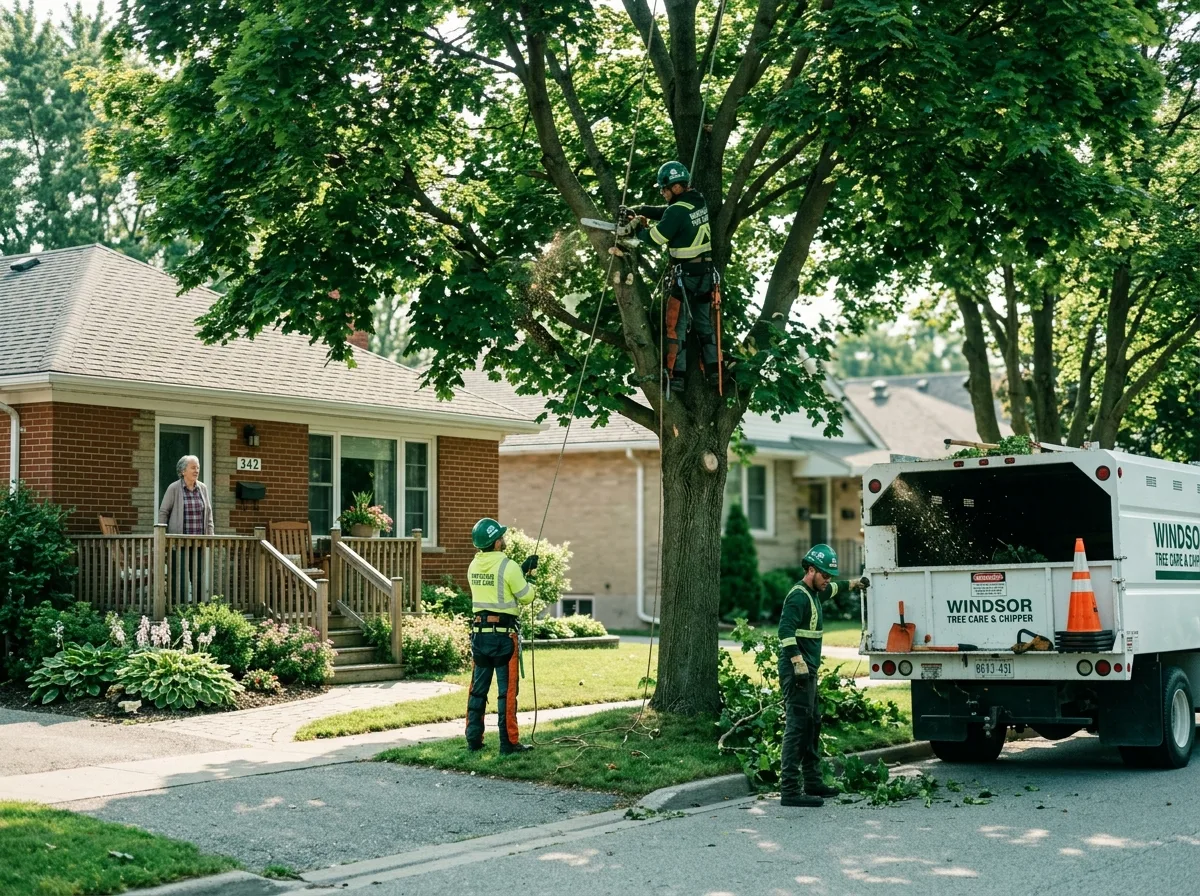
Tree Removal Windsor trims, thins, and removes cedar hedges across the county. We trim to keep hedges in the green rather than cutting to a line and hoping, and we will tell you honestly if a row is beyond rescue.
Serving Windsor, LaSalle, Tecumseh, Amherstburg, Leamington, Kingsville, and Essex.