If you have a mulberry, you probably did not plant it.
That is the thing about mulberry in this city. Nobody chooses it. Birds eat the fruit, birds sit on the fence, and a mulberry appears along the property line. Give it eight years and it is a substantial tree growing out of a spot nobody would ever have picked.
Windsor alleys are full of them. So are fencelines, garage foundations, the gap behind the shed, and the strip between two driveways.
The one you have is probably the invasive one
There are two mulberries in play here and it matters which you have.
Red mulberry, the native one
Endangered in Ontario. Genuinely rare, genuinely protected, and Essex County is one of the few places in Canada it still occurs. Leaves are large, dull on top, and noticeably fuzzy underneath.
White mulberry, the introduced one
From Asia, and this is the one growing out of your fence. It is classed as invasive in Ontario, it is aggressive, and it hybridizes with red mulberry, which is one of the main reasons the native tree is in trouble. Leaves are glossy on top, mostly smooth underneath, and wildly variable in shape, often with deep irregular lobes on the same branch as unlobed ones.
The odds strongly favour white mulberry in a Windsor yard. But if there is any chance it is a red, get it identified before you cut, because removing an endangered native tree is a different legal situation entirely. Federal protection under the Species at Risk Act applies regardless of what your municipality's bylaws say. This is a real consideration in Essex County in a way it is not anywhere else in the province, and our arborist service can confirm the species.
Why people want them out
The fruit
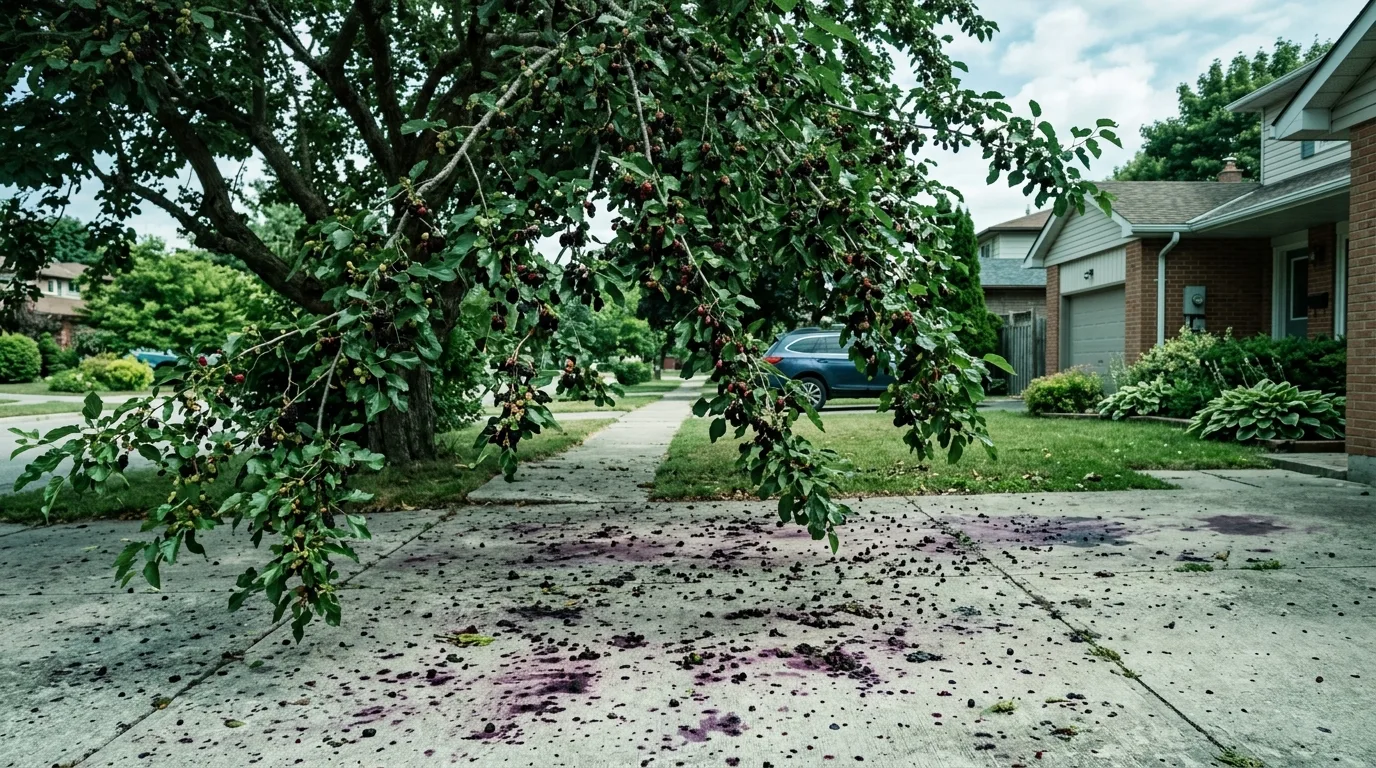
This is the main one. A mature mulberry drops fruit for weeks in early summer, and the fruit is dark purple and it stains. Driveways, patios, car roofs, siding, the dog, the bottom of everyone's shoes and then the kitchen floor. Under a mulberry, a concrete driveway ends up permanently mottled.
Where they grow
Mulberry seedlings establish against foundations, in fence lines, and up against garages. By the time the tree is worth noticing, the trunk is pressed against something structural and the roots are under it.
Roots
Shallow, aggressive, and enthusiastic about the same clay-soil sewer joints that silver maple roots find.
Weak structure
Fast growth, brittle wood, poor branch attachment. Mulberry limbs come down in storms more often than they should for their size.
Volunteers everywhere
One productive tree seeds a whole block. You end up pulling mulberry seedlings out of the garden every spring.
The thing that makes mulberry removal different
Mulberry resprouts. Aggressively.
Cut a white mulberry off at ground level and leave the stump, and you will have a cluster of vigorous shoots coming out of it within a single growing season. Ten of them, growing faster than the original did. Cut those, and it does it again.
This is the mistake we get called to fix most often. Somebody took a mulberry down two summers ago and now there is a thicket where the tree was.
The stump has to be ground out, or the cut surface has to be treated. Grinding is the reliable option, and on mulberry it is not optional the way it might be on a maple. Budget for stump grinding when you budget for the removal.
Same goes for root suckers. Mulberry can throw shoots from roots some distance from the trunk, so expect to deal with a few in the following season even after grinding.
The access problem
Most Windsor mulberries are in genuinely awkward spots. Against a garage, in an alley with no vehicle access, wedged between two fences, over a neighbour's shed.
That is the actual cost driver on these jobs. Not the size of the tree, but whether we can get to it and where the wood goes. A 30cm mulberry in an open backyard is a straightforward morning. The same tree behind a garage in an alley off Drouillard, with no gate wide enough for a chipper, is a different quote. More on how that works in why tree removal quotes vary so much.
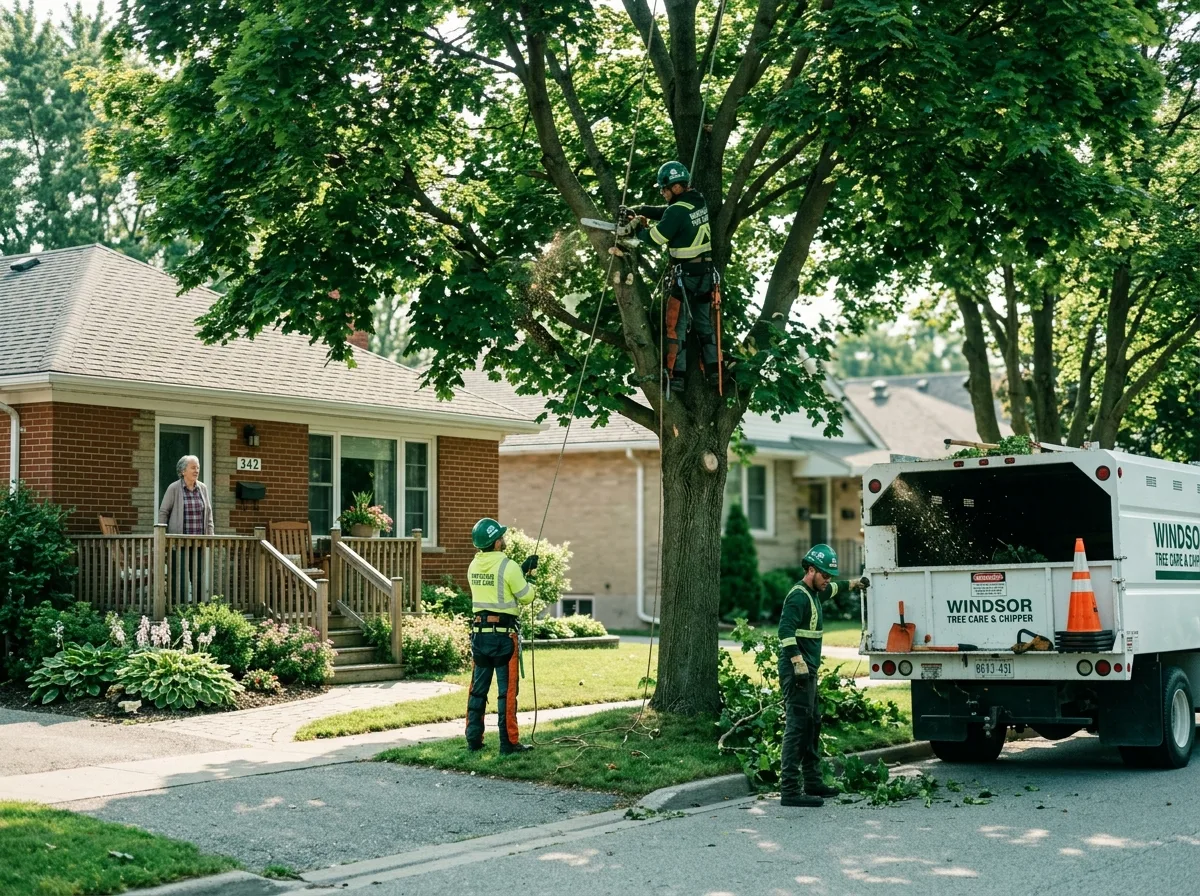
We do a lot of this work and it is most of why we own the equipment we own. We can rig a tree out over a fence in pieces and carry it out rather than needing to drive anything in, which on a lot of these lots is the only way it happens at all.
Is it ever worth keeping?
If it is a confirmed red mulberry, yes. That is a rare native tree and it should stay.
If it is a white mulberry well away from the house and driveway, and you do not mind the fruit or you actively want it for the birds, it is a functional shade tree. No shame in leaving it.
If it is against your foundation, over your driveway, or seeding the whole street, take it out properly.
Getting it done
Tree Removal Windsor removes mulberry across the county, including the alley and fenceline jobs where nothing can be driven in. We grind the stumps, because with mulberry that is the difference between a removal and a delay.
- Tree removal in Windsor
- Stump grinding
- Species identification and arborist reports
- Lot clearing for heavier overgrowth
Serving Windsor, LaSalle, Tecumseh, Amherstburg, Leamington, Kingsville, and Essex.
Send a photo and we will give you a ballpark. Start here.