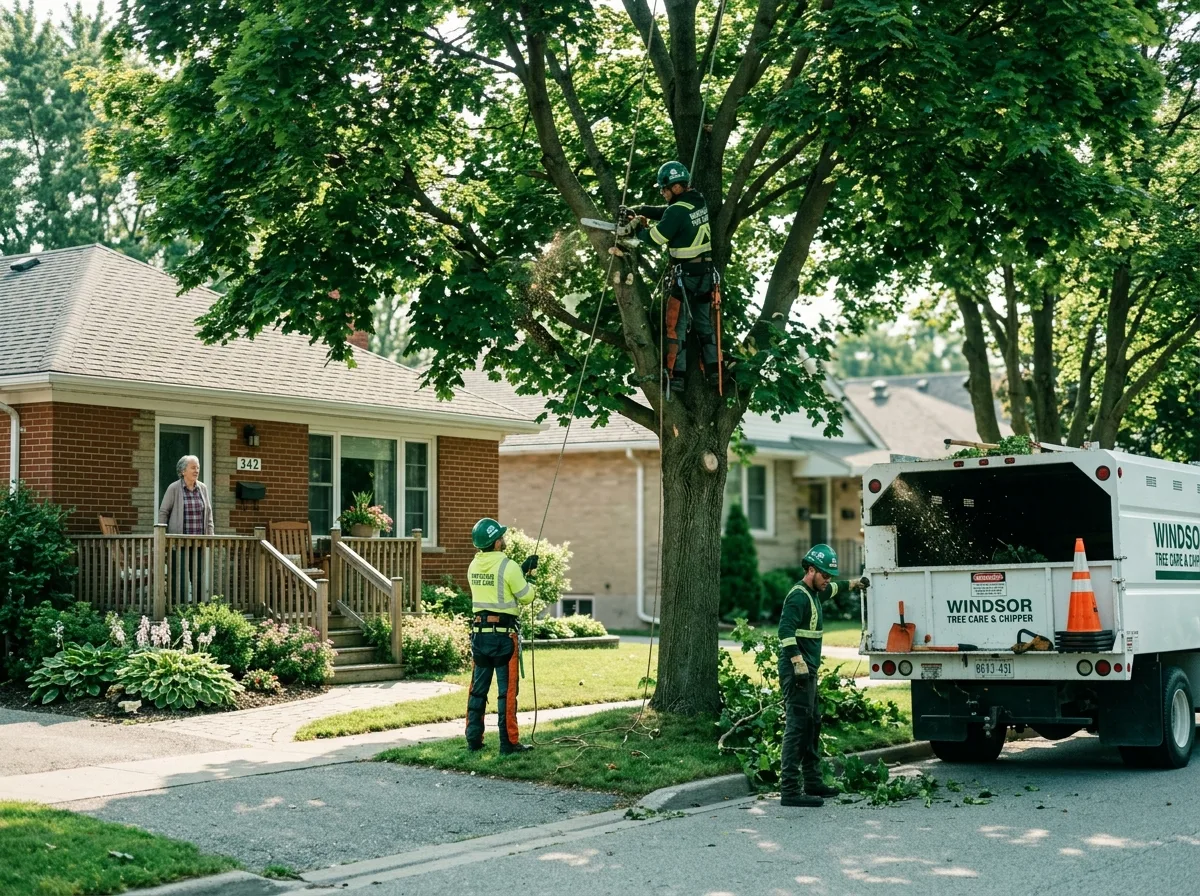
Short answer, and it surprises people who have moved here from the GTA: in Windsor and across Essex County you generally do not need a permit to remove a tree on your own property.
That is genuinely different from Toronto or Mississauga, where a permit is required above a set trunk diameter. The bylaws in this region were written to protect public trees, not private ones.
There are still four things that can apply. Work through them in order.
Step one: whose tree is it?
This trips up more Windsor homeowners than anything else, and it is the question that actually decides everything.
What matters is where the trunk sits. Not the branches, not the roots. The trunk.
Trunk on municipal property
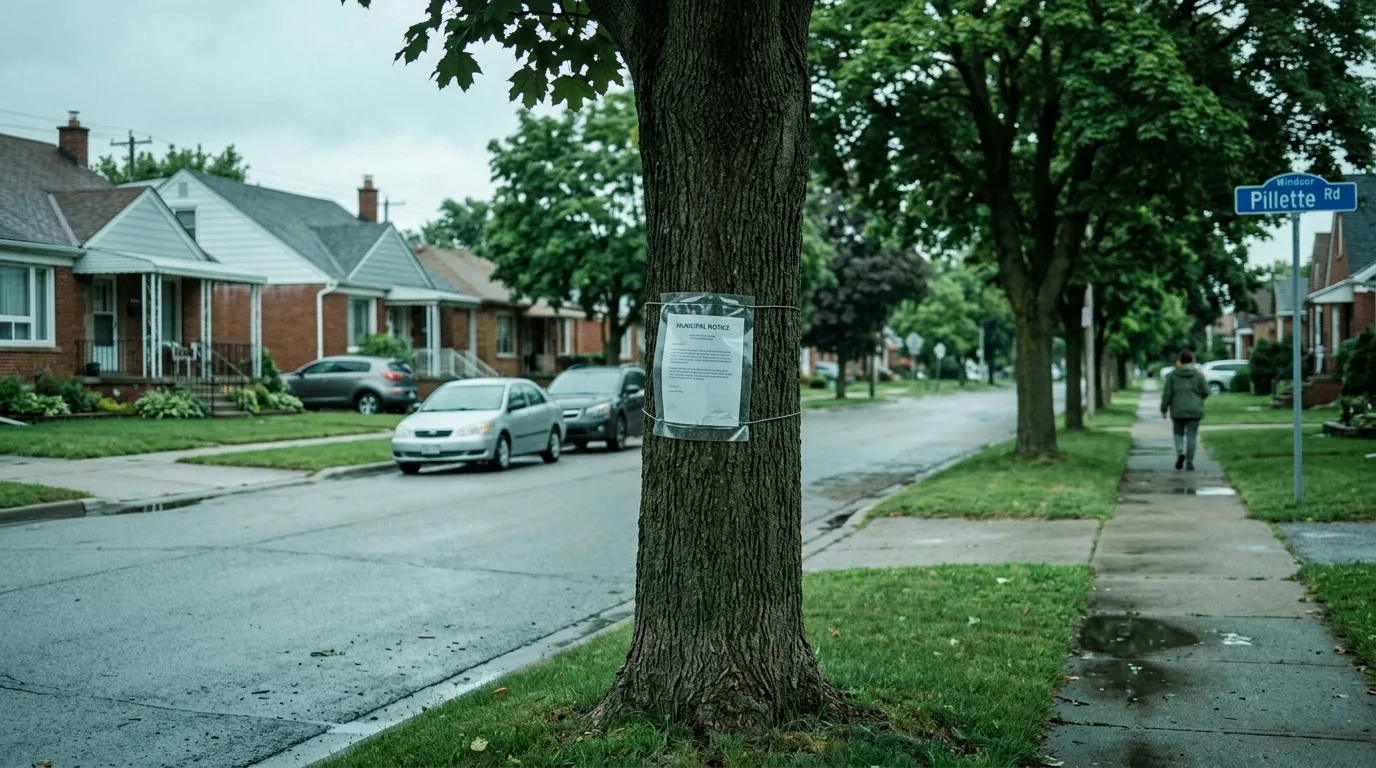
If the trunk stands on the boulevard strip between sidewalk and curb, on the road allowance, or in a park, the tree belongs to the municipality. You cannot cut it and neither can we.
City trees in Windsor are protected under by-laws 135-2004 and 131-2019, and removal has to be approved by an authorized City of Windsor arborist. The process is to request an inspection or contact 311. An arborist decides whether the tree is healthy and viable or should come down, and you get a letter with the outcome. If removal is approved, the city schedules it based on priority, and the stump is taken out separately, which can take up to twelve months after the tree itself.
The other municipalities work the same way, with their own bylaws covering public trees: Kingsville By-law 71-2014 prohibits injury or destruction of trees on public property, Amherstburg By-law 2016-94 regulates public trees, LaSalle has a Trees on Municipal Property Maintenance Policy, and Tecumseh operates under Tree Maintenance and Removal Policy No. 108.
The boulevard confusion is real, because homeowners mow that grass, water it, and reasonably assume it is their yard. In most Windsor neighbourhoods it is not. Your survey will show the line, or the municipality can confirm it.
Trunk on the property line
If the trunk straddles the boundary between you and a neighbour, it is a shared tree under Ontario's Forestry Act, and you need the neighbour's consent to remove it. Not their opinion, their consent. Removing a boundary tree without it exposes you to real liability.
Trunk entirely on your land
It is your tree. Move to step two.
Step two: is there a private tree bylaw where you live?
In Windsor-Essex, generally no.
The Town of Essex, for example, has no bylaw requiring a permit to remove a tree on private residential or agricultural property. The County of Essex spent time developing a Natural Heritage Areas Preservation By-law and then stepped back from it. County planning staff advised that neither the county nor the individual municipalities were in a position to enforce a tree cutting bylaw, and council moved instead toward reviewing site alteration provisions in the county Official Plan. Several local mayors argued at the time that a restrictive private-property bylaw would be the wrong tool.
So the honest position is that private tree removal in this region is largely unregulated at the municipal level. Bylaws do change, so confirm with your own municipality before a large job, but you are unlikely to need a permit.
Step three: the overlays that do still apply
This is where people get caught out, because these have nothing to do with tree bylaws.
Conservation authority regulated areas
If your property sits near a watercourse, a wetland, or a shoreline, the Essex Region Conservation Authority may have jurisdiction regardless of what your municipality says. That covers a lot of land in this county, since we are surrounded by water on three sides. Check with ERCA if you are anywhere near a drain, creek, or shoreline.
Natural heritage features and the county Official Plan
Designated woodlands and natural heritage features are addressed through the county Official Plan's natural environment policies. If you own a woodlot rather than a yard tree, this is the section that matters.
Species at Risk Act
Federal protection applies to certain species regardless of where they grow. This matters more in Essex County than almost anywhere else in Canada, because we are in the Carolinian zone and hold a disproportionate share of the country's species at risk. Red mulberry and butternut are both protected and both get confused with common look-alikes. Worth an arborist identification before the saw comes out.
Migratory Birds Convention Act
Active nests are federally protected during nesting season, roughly April through August. This is the most commonly overlooked rule in residential tree work, and it applies to everybody.
Step four: is the removal tied to construction?
If the tree is coming out for a new build, an addition, a pool, or a lot severance, the tree question usually gets handled through the site plan or building permit process rather than as a standalone tree matter. You will likely need an arborist report and a tree assessment as part of the environmental impact work.
Talk to us early on those rather than after the application has stalled. Our lot clearing service and arborist reports are both built around this.
What about free tree removal?
A fair number of people searching for free tree removal in Windsor are hoping the tree belongs to the city. Sometimes it does, which takes you back to step one.
If the trunk is on municipal property and the tree is dead, diseased, or hazardous, the municipality handles it at no cost to you, on their schedule. The schedule is the catch, and non-emergency removals get triaged.
If the tree is on your property, nobody is removing it for free. Outfits advertising free removal in exchange for the wood are usually after high-value timber, mature black walnut mostly, and the offer tends to evaporate once they see the tree.
Where we come in
Tree Removal Windsor works across all seven municipalities and deals with these questions constantly. We will tell you which rules apply to your address, write the arborist report if a development application needs one, and decline a job if the tree is not yours to cut.
- Tree removal in Windsor
- Arborist reports and assessments
- Lot clearing for builders and developers
- About us
Serving Windsor, LaSalle, Tecumseh, Amherstburg, Leamington, Kingsville, and Essex.
Not sure whose tree it is? Send us a photo showing the trunk, the sidewalk and the curb, and we can usually tell you.
Bylaws and policies change. This reflects the rules as they stood at the time of writing and is not legal advice. Confirm with your municipality before a major removal.