We get asked this a few times a year. Can you treat the ash instead of taking it down?
The honest answer is usually no, and we would rather say that up front than sell somebody two rounds of injections on a tree that was already finished.
What treatment actually is
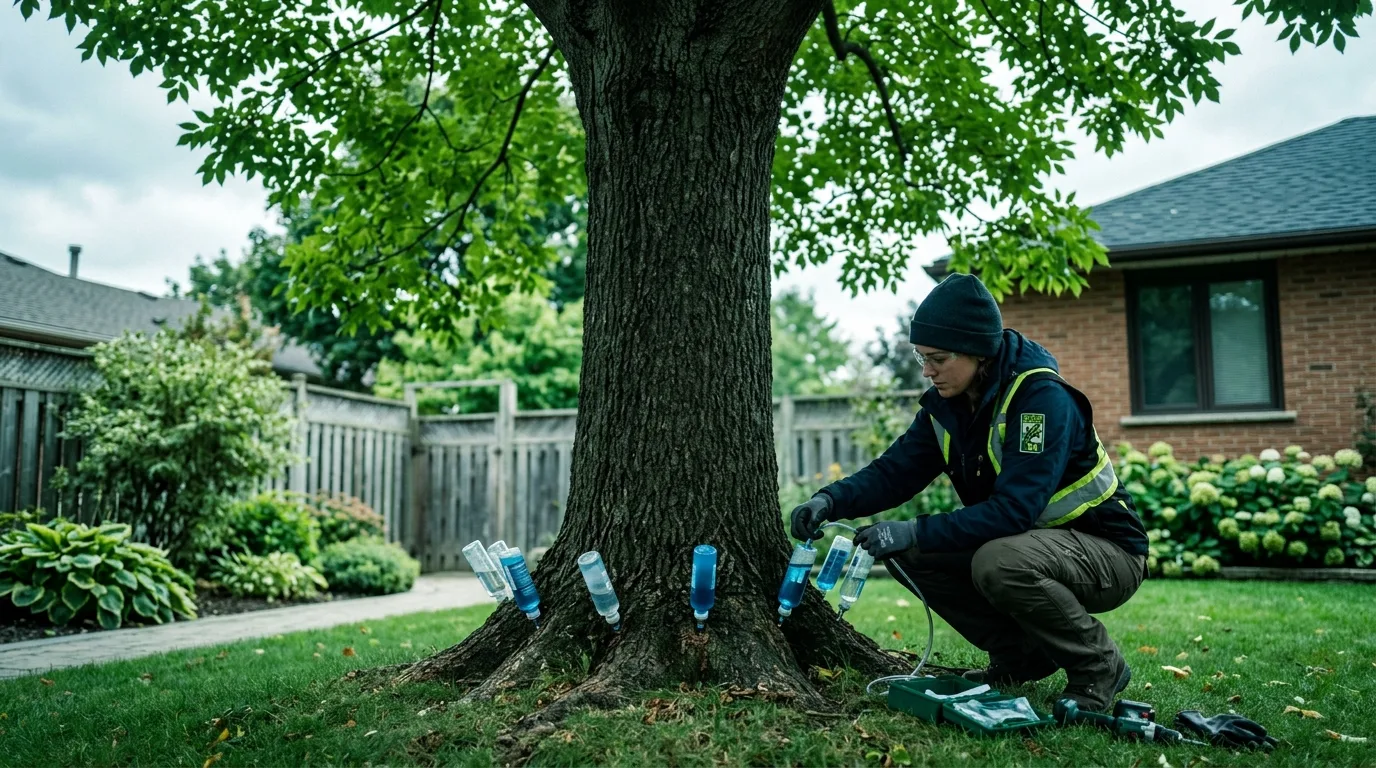
There is a registered injection, and the common one in Canada is derived from neem, that goes directly into the trunk. It moves up through the tree's own plumbing and kills larvae feeding in the tissue under the bark.
It works. That is not in question. But it works as protection, not as a cure.
An injection has to be in the tree before the borer population is established, and it has to be repeated. Typically every two years, for as long as you want the tree protected, which in practice means indefinitely. Stop injecting and the tree goes back to being defenceless.
Cost runs by trunk diameter. A mid-sized yard ash, say 40 to 60cm through, will generally land somewhere in the low to mid hundreds per treatment. Over ten years that is several thousand dollars, and you still own an ash tree at the end of it.
Why the math usually fails here
Windsor is where the borer entered Canada, in the summer of 2002, crossing over from the Detroit area. Tree ring evidence says it was probably here since the early 1990s.
That is the whole problem in one sentence. Essex County has had the beetle for a generation. Every ash in the county has been exposed, repeatedly, for over twenty years.
Treatment protects trees that have not been hit yet. There is essentially no such ash left here. The window that a homeowner in eastern Ontario had in 2015, where treating a healthy ash was a genuinely good decision, closed in this county before most people knew the beetle existed.
So when we look at an ash in Windsor and somebody asks about injections, we are almost always looking at a tree that already has galleries under the bark. Injecting it does not undo damage to the tissue that moves water. You would be paying to protect plumbing that has already been cut.
The rough threshold most arborists work to: once a tree has lost more than about a third of its canopy, treatment stops being a reasonable bet. Past halfway, it is not a bet at all.
When treatment still makes sense
It is not never. Two situations come up.
A blue ash with a full crown
Blue ash holds up against the borer better than the other native ash species, and it is an uncommon tree of southwestern Ontario. Essex County is one of the few places you would find one. If you have a blue ash still carrying a healthy canopy after all this time, protecting it can be worth the money, because you own something genuinely unusual. Get the species confirmed first through an arborist assessment.
A large, sound, well-placed ash above 80 percent canopy
Rare here, but they exist. Usually irrigated, usually in a spot with decent soil and no compaction. If that tree is providing real shade on the west side of a house, the injection bill can compete with the removal bill plus twenty years of waiting for a replacement to grow.
Outside of those two, we would tell you to spend the money on removal and a replacement tree.
The comparison nobody runs
People compare treatment cost against removal cost, and treatment often looks cheaper per year. That is the wrong comparison.
Run it this way instead.
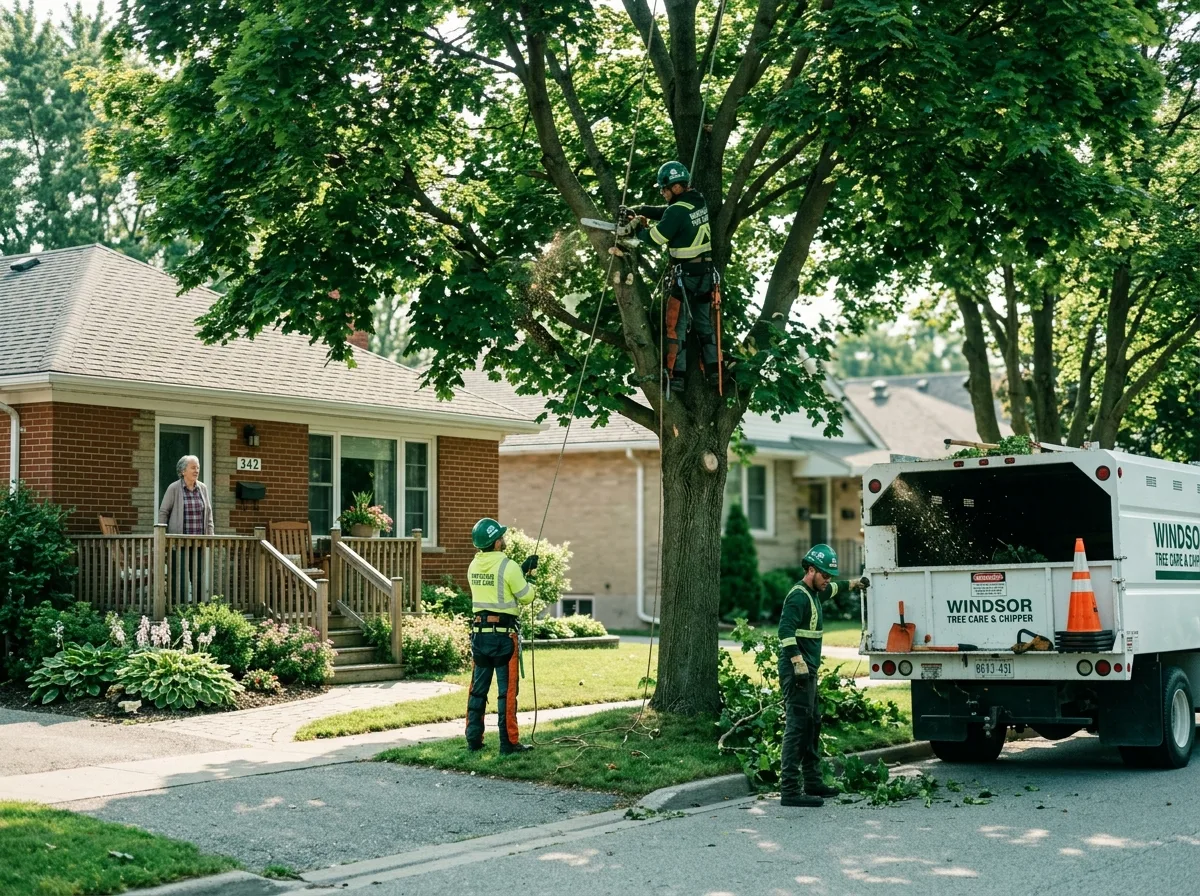
Removal now, on a tree that is still climbable, is the cheapest version of the removal you will ever be quoted. Dead ash goes brittle. Once a climber cannot tie into it, you are paying for a bucket or a crane, and the number goes up substantially. We have seen the same tree go from a straightforward climb in spring to a crane job by September.
So the real choice is not treatment versus removal. It is removal now versus a worse removal later, plus whatever the treatments cost in between, plus the risk of a limb finding your fence or your neighbour's car in the meantime.
Put that way, it is usually not close.
What we would suggest
Have somebody assess the tree honestly before you spend anything. If it is treatable, we will say so. If it is not, you should know that before you have paid for an injection.
Tree Removal Windsor does a lot of ash work, including the awkward brittle ones in tight backyards, and we do not sell treatments we do not believe in.
Serving Windsor, LaSalle, Tecumseh, Amherstburg, Leamington, Kingsville, and Essex.
Free assessment, number in writing. Get a quote.