The emerald ash borer arrived in Canada at Windsor, in the summer of 2002. It had already established itself across the river around Detroit, and it crossed. Most likely in wood packaging or pallets moving through the border, though nobody can point at a single shipment and say that one.
If you live in Windsor or anywhere in Essex County, you were living at the front edge of the worst tree die-off in Canadian history, and you probably did not know it for another five or six years.
Here is the part most people find hard to believe. By the time anyone identified the beetle in 2002, it had already been here for close to a decade. Researchers went back and read the growth rings in dead ash around Detroit and Windsor, and the damage traced to the early 1990s. So the discovery was not an arrival. It was somebody finally noticing.
Where the beetle came from
The emerald ash borer is native to Asia: China, Japan, Korea, Taiwan, Mongolia, and the Russian Far East. Over there it is a minor pest, because Asian ash species evolved alongside it and can fight it off.
North American ash never had to. Our trees had no defences, and the beetle had no predators here worth mentioning. That combination is why it moved the way it did.
How it spread out of Windsor
Adult beetles fly, but not far. Left alone, the infestation would have crept outward a few kilometres a year.
It did not creep. It jumped hundreds of kilometres at a time, because people moved firewood. Somebody cuts up a dead ash in Windsor, throws it in the truck, drives to a cottage north of Sault Ste. Marie, and the larvae overwintering in that wood emerge somewhere new the following spring.
From Windsor the beetle has since been confirmed across six provinces and more than thirty American states. Ontario infestations run from here up to Grey County and east to Ottawa, with separate pockets on Manitoulin Island and around Sault Ste. Marie.
Firewood movement restrictions are still in place for exactly this reason. They are worth taking seriously even now.
What happened to the ash trees
Roughly 99 percent mortality in an infested area within about eight to ten years. Not most of them. Effectively all of them.
How the beetle actually kills a tree
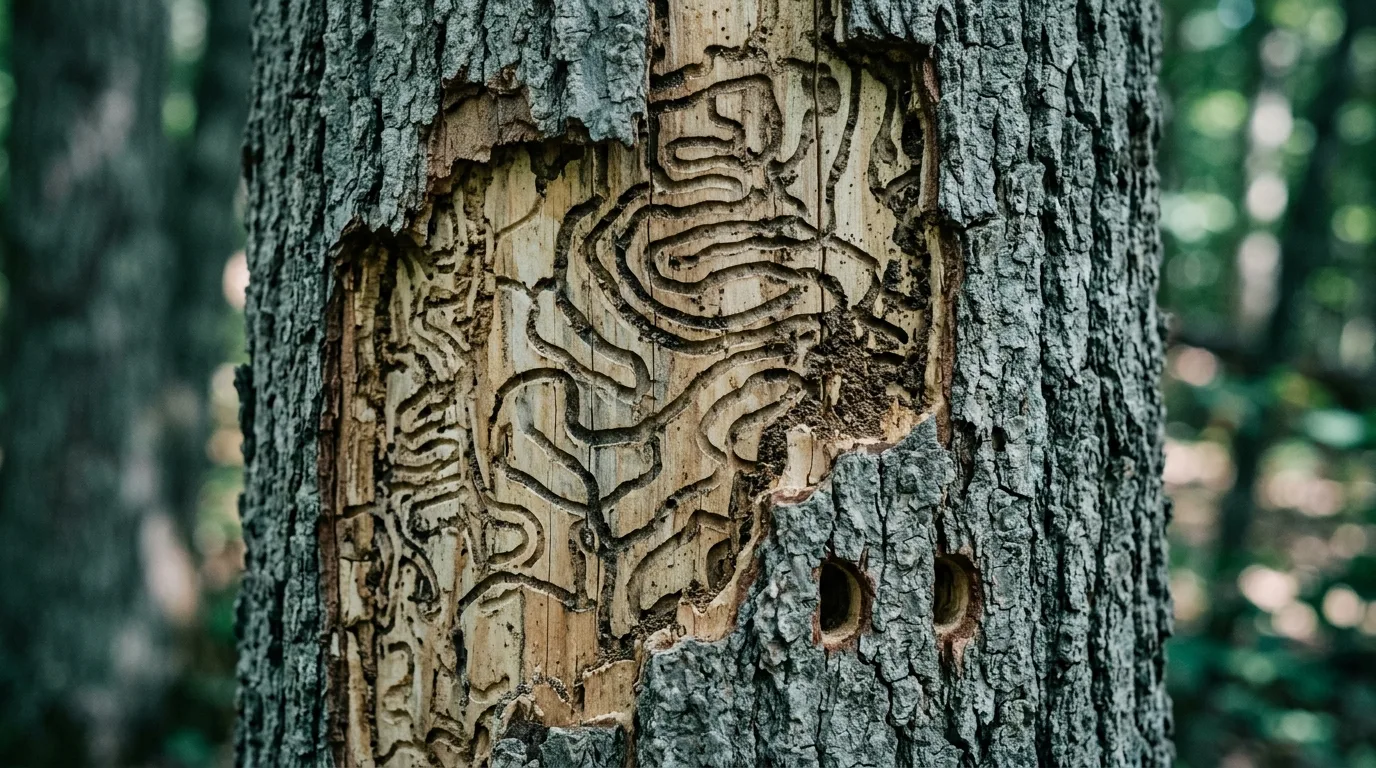
The adult lays eggs on the bark. Larvae hatch and tunnel into the layer just underneath, chewing S-shaped galleries through the tissue the tree uses to move water and sugar. Enough of those and the tree is girdled from the inside. It starves.
What decline looks like
Ash decline starts at the top. Leaves stop coming out on the upper branches, and the dieback works downward year over year. Meanwhile the trunk often throws out a mess of frantic new shoots down low. That is the tree panicking, not recovering.
One local exception worth knowing about
Five native ash species get attacked here. Four of them are highly susceptible. Blue ash is the odd one out. It holds up noticeably better than the rest, and it is an uncommon tree that happens to grow in southwestern Ontario.
Essex County is one of the few places in Canada where you might actually have one. It is not immunity, but a blue ash still standing with a full crown in 2026 is a genuinely different situation from a green or white ash in the same condition. Worth having someone identify which you have before you decide anything. Our arborist services in Windsor cover species identification.
If you still have an ash tree in Windsor-Essex
Be careful about what you are looking at. Twenty-four years past ground zero, a standing ash here is almost never a healthy tree that has not been found yet. It is usually a dead or dying tree that has not come down yet.
That distinction matters more than people expect, because dead ash does not behave like other deadwood. It goes brittle fast. Limbs snap off with no warning and no bend to them. Climbers will not tie into a long-dead ash, which is why these removals often need a bucket or a crane, and cost more than an equivalent live maple would.
We have had homeowners in South Windsor and Tecumseh call in October about a tree they had been keeping an eye on since spring, after a limb went through a fence. The tree was unclimbable by then. Waiting made the job bigger and more expensive, not cheaper.
Get the tree looked at
If you have an ash on your property, or something you think might be an ash, have somebody put eyes on it before the next windstorm decides for you.
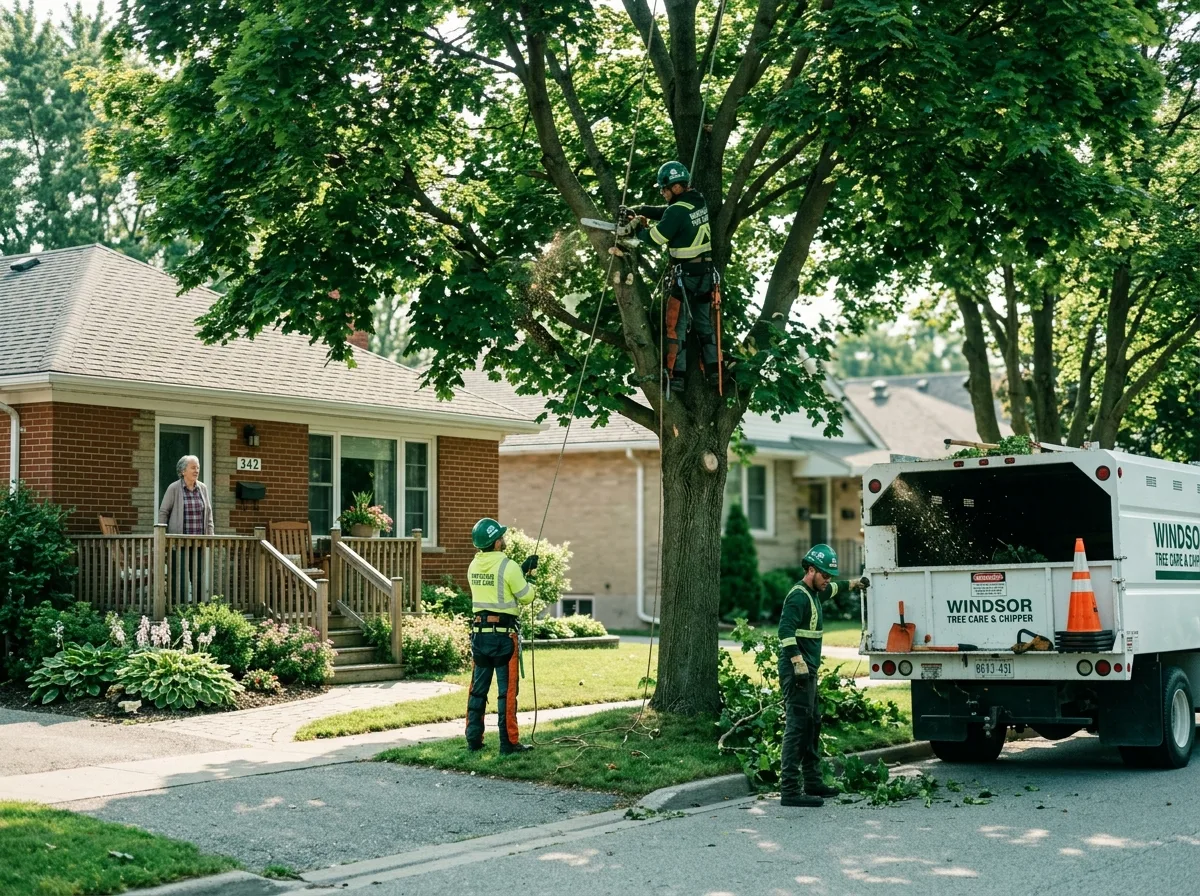
Tree Removal Windsor takes down dead and declining ash across the county. We work in tight backyards without tearing up the lawn, we carry full liability insurance and WSIB clearance, and we will tell you straight whether a tree needs to come down.
- Tree removal in Windsor
- Emergency tree removal if a limb has already come down
- Stump grinding
- About Tree Removal Windsor
We also cover LaSalle, Tecumseh, Amherstburg, Leamington, Kingsville, and Essex.
Assessments are free and you get the number in writing. Request a quote.