Most people who call us about an ash tree are not sure it is an ash. That is fair. Once the leaves are gone there is not much to go on unless you know what you are looking at.
Is it actually an ash?
Three things to check, and you want all three, not one.
Opposite branching
Branches come off the trunk directly across from each other, one on the left, one on the right, at the same height. Maples do this too, which is where most misidentification happens.
Compound leaves
One ash leaf is actually a stem with five to eleven leaflets running down either side and a single one at the tip. What most people picture as an ash leaf is really one leaflet.
Diamond-pattern bark
The bark on a mature trunk is a tight diamond grid, with ridges crossing each other in a regular pattern like a net. That is the giveaway on a big tree in winter.
Ash also holds a distinct seed: a single flat paddle, hanging in clusters. Not the two-winged helicopter a maple drops.
If you have opposite branches but the leaves are simple and single, you probably have a maple. If the bark is shaggy and peeling and the branches alternate, you are likely looking at a hackberry or an elm.
Signs the borer is in it
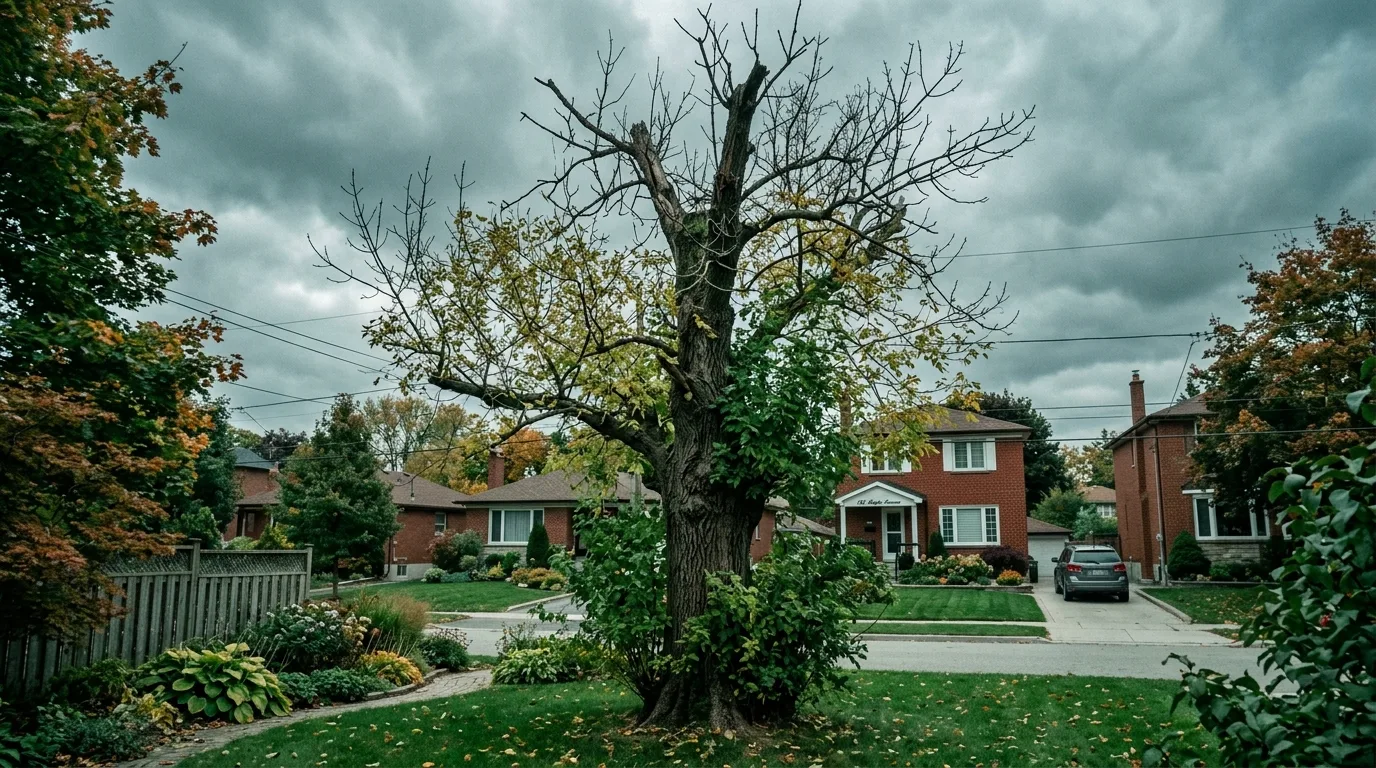
Look at the top first. Ash decline starts high and moves down. If the upper third of the crown is bare or thin while the lower branches still leaf out, that is the pattern.
Then look for the rest of it.
- D-shaped exit holes in the bark, about 3 to 4mm across, flat on one side. Round holes are a different insect.
- Bark splitting vertically, and underneath the split, S-shaped tunnels packed with sawdust-coloured material. Those galleries are the actual damage.
- Woodpecker work. Patches of bark flaked off high in the canopy, pale against the darker bark. Woodpeckers find the larvae before we do, so heavy flecking up top is a strong signal.
- Shoots sprouting from the base of the trunk or straight out of the bark on the main stem. The tree trying to grow leaves anywhere it still can.
You will probably never see the beetle. It is about a centimetre long, bright metallic green, and only flying for a few weeks in early summer.
Why Windsor-Essex is different from the rest of Ontario
The borer got into Canada at Windsor in 2002, and had likely been in the area since the early 1990s. We are twenty-four years past that. Essex County did not get a warning period. We were the warning period for everywhere else.
Which means a standing ash in Windsor today is almost never an undiscovered healthy tree. It is a tree that has already been through it. Either it is dead and has not come down, or it is the rare one that had something going for it.
One thing worth checking before you write it off. Blue ash holds up against the borer noticeably better than the other native ash species, and it is an uncommon tree of southwestern Ontario. Essex County is one of the only places in the country you would find one in a yard. If your ash still has a full crown after all this time, have somebody identify the species properly rather than assuming it is finished.
Why dead ash cannot wait
This is the part we would most like homeowners to hear.
Dead ash does not behave like other dead trees. The wood dries out and goes brittle in a way that oak and maple do not. Limbs do not bend, sag, and then fail. They let go all at once, usually with no visible warning and no sound until they hit.
For us that changes the whole job. A climber cannot safely tie into a long-dead ash, so what would have been a straightforward climb and rig becomes a bucket job, or a crane job if access is poor. That costs more. It also means the window where the cheap version of the removal was possible has usually closed by the time somebody calls.
We had a call out of Riverside last fall. Homeowner had been watching an ash since the spring, waiting to see if it would leaf out. It did not, and a limb came down across a fence in September. By then nobody was climbing it, and the removal cost roughly double what it would have in April.
Waiting on a dead ash does not save money. It moves the cost and adds risk.
Get it identified
If you are not sure what you have, or you are sure and you have been putting it off, have somebody look at it.
Tree Removal Windsor handles a lot of these: brittle removals in tight backyards, over fences and sheds and pools, without heavy equipment on your lawn. Full liability insurance, WSIB clearance, written quotes.
Also serving LaSalle, Tecumseh, Amherstburg, Leamington, Kingsville, and Essex.
Free assessment, and if the tree can stay we will tell you that too. Book one here.