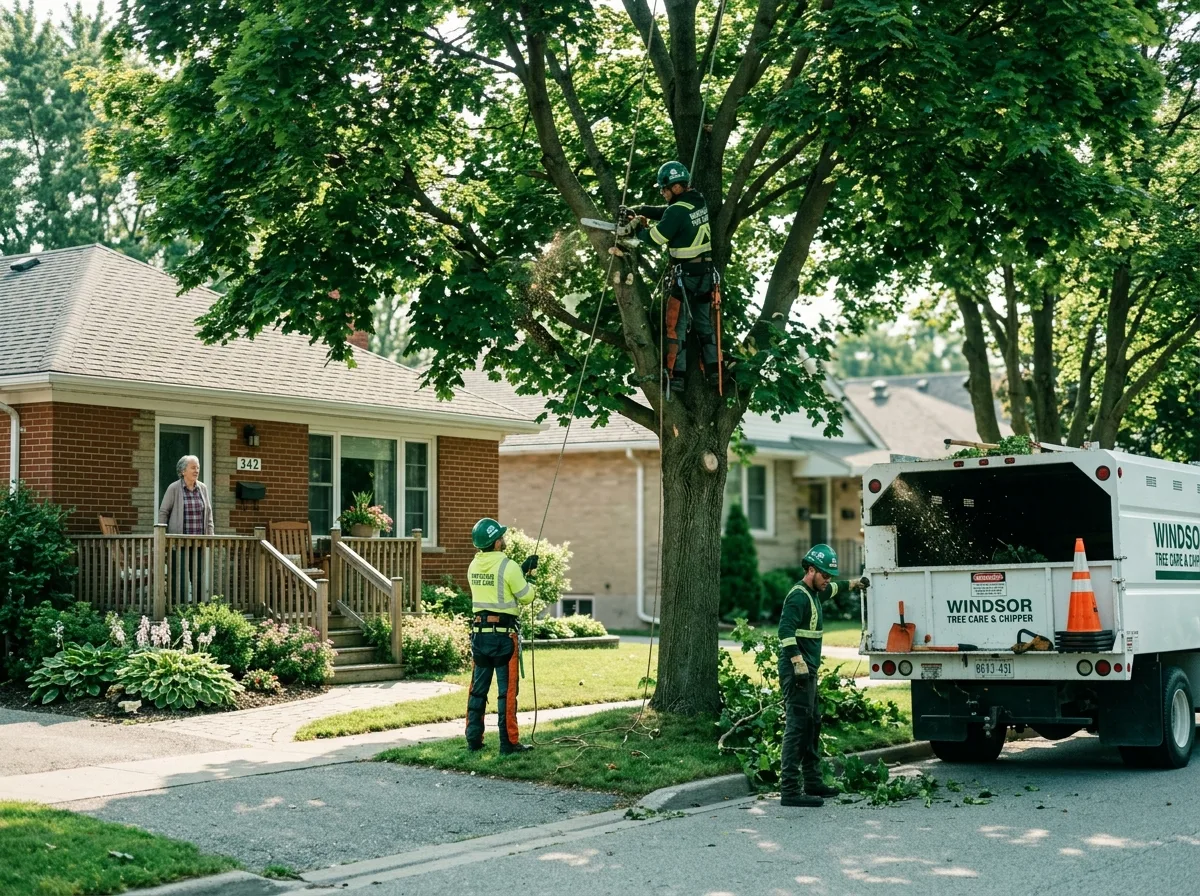
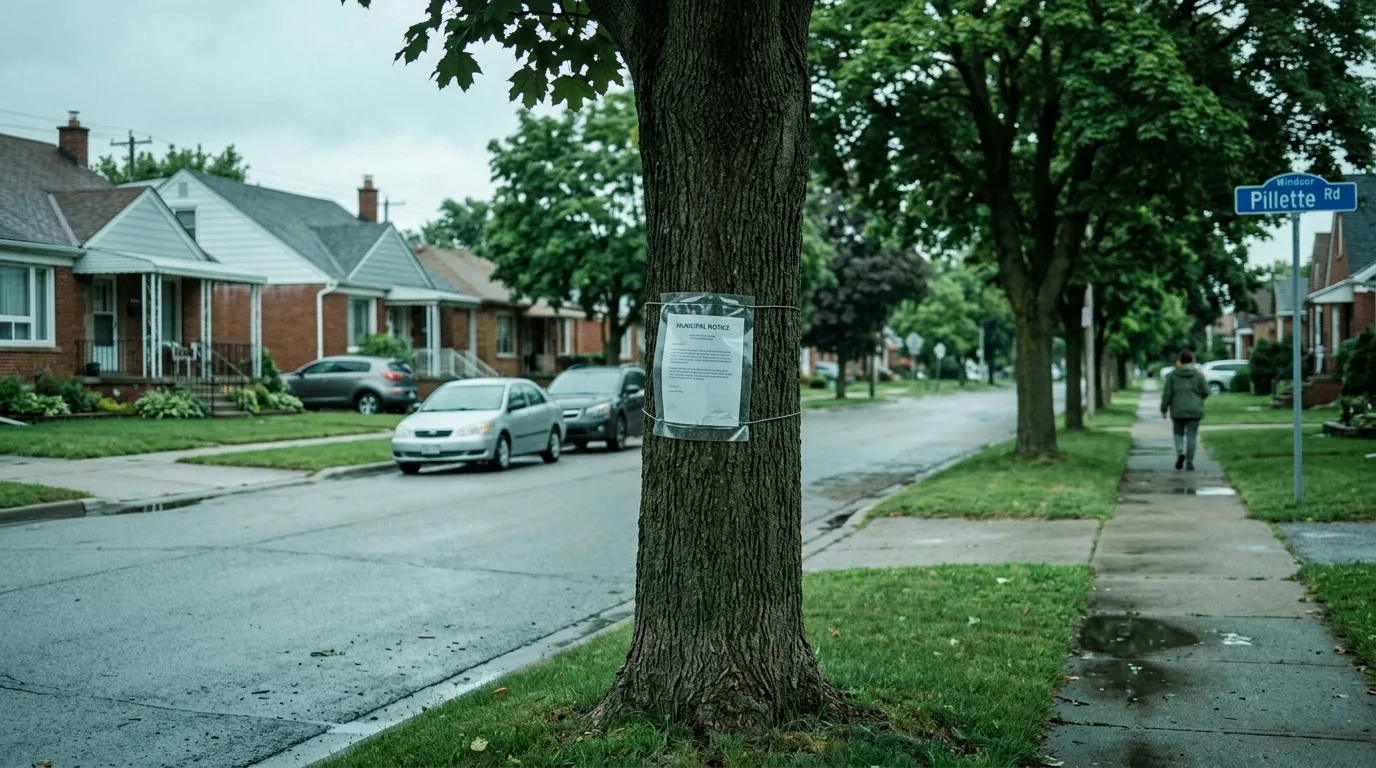
One question decides this. Where is the trunk?
Not the branches. Not the roots. The trunk. That determines ownership, and ownership determines who pays and who is allowed to cut.
When it is the city's tree
If the trunk stands on municipal property, meaning the boulevard strip between sidewalk and curb, the road allowance, or a park, the tree belongs to the City of Windsor.
You submit a service request. You do not hire us, and we would decline the job if you asked, because cutting a municipal tree without authorization is an offence and the liability lands on whoever swung the saw.
How the process actually works
City trees in Windsor are protected under by-laws 135-2004 and 131-2019, and removal has to be approved by an authorized City of Windsor arborist.
You request an inspection or contact 311. A city arborist attends and determines whether the tree is healthy and viable or should be removed. After the inspection you get a letter with the outcome. If removal is approved, the city schedules it based on priority, which can shift depending on storms, safety, or changes in the structure of the tree.
The stump is handled as a separate job, and that can take up to twelve months after the tree itself comes down. Worth knowing before you plan a landscaping project around it.
What the city handles at no cost to you
- Removal of dead, dying, diseased, or structurally hazardous boulevard and park trees, once an arborist has approved it
- Emergency response for municipal trees that have come down or are about to, particularly across roads or onto property
- Pruning of boulevard trees for clearance and deadwood on their maintenance cycle
What the city will not do
Remove a healthy municipal tree because you do not like it. Leaf drop, shade over your garden, roots in your lawn, fruit on your driveway, and blocking your view are not grounds for removal. This is the most common source of frustration and the answer is consistently no.
Remove a tree on your private property, at any cost, under any circumstances.
Prune a municipal tree on your schedule rather than theirs.
The honest catch: timelines
The city's work is triaged, and it should be. A tree down across Tecumseh Road gets dealt with today. A declining boulevard maple with some deadwood goes into a queue based on priority.
That is not a criticism, it is a resourcing reality every municipality in Ontario deals with. But it is worth knowing before you decide to wait, and it is worth knowing that you cannot pay to jump the queue or hire us to do it faster.
The rest of Essex County works the same way
Each municipality has its own bylaw or policy covering public trees, and the pattern is the same: request an inspection, municipal staff decide, municipal crews do the work.
- Kingsville: By-law 71-2014, prohibiting the injury or destruction of trees on public property
- Amherstburg: By-law 2016-94, regulating planting, preservation, maintenance and removal of public trees
- LaSalle: Trees on Municipal Property Maintenance Policy
- Tecumseh: Tree Maintenance and Removal Policy No. 108
When it is your tree
Trunk entirely on your property means it is yours. The city has no role, no obligation, and no cost-sharing program for it.
That includes trees whose branches hang over the sidewalk and trees whose roots are lifting the city's sidewalk. Annoying, but the trunk decides it.
You hire a private company. In Windsor-Essex you generally will not need a permit for private-property removal, unlike much of the GTA, though there are federal and conservation-authority overlays worth checking. See do you need a permit to remove a tree in Windsor-Essex.
The awkward third category: boundary trees
If the trunk straddles the line between your property and a neighbour's, it is a shared tree under Ontario's Forestry Act. You need your neighbour's consent to remove it, meaning genuine consent, not a heads-up.
If the trunk straddles the line between your property and city land, contact the city before doing anything. Those get handled case by case.
Where the confusion usually comes from
The boulevard
Homeowners mow that strip, water it, rake it, and reasonably conclude it is theirs. In most Windsor neighbourhoods it is not.
If you are unsure, your property survey will show the line, or the city can confirm. Do this before you get quotes, because a quote on a tree you do not own wastes everybody's time.
Overhanging branches
You are generally entitled to prune branches back to your property line, but you cannot cross onto the neighbour's or the city's land to do it, and you cannot damage the tree's health. On a municipal tree you should ask first. Cutting a city tree back hard because it overhangs your driveway can put you in trouble.
So which do you call?
- Trunk on the boulevard, road allowance, or in a park: call the city or 311, expect to wait, and accept the answer if the tree is healthy
- Trunk in your yard: call a private company
- Trunk on the line: sort out consent before anything else
- Tree down on a wire: call your electricity distributor first, regardless of who owns the tree
If it is yours
Tree Removal Windsor handles private tree work across the county. We will tell you honestly if the tree you are calling about is actually the city's and point you at the right place, because we would rather do that than quote a job we cannot legally take.
- Tree removal in Windsor
- Emergency tree removal
- Arborist assessments and reports
- Stump grinding, including on stumps the city has left behind
- About us
Serving Windsor, LaSalle, Tecumseh, Amherstburg, Leamington, Kingsville, and Essex.
Not sure whose tree it is? Send a photo showing the trunk, the sidewalk and the curb, and we can usually tell you. Get in touch.
Municipal processes and bylaws change. Confirm current details with your municipality before relying on this.