After the ash borer went through, this county had to replant tens of thousands of trees. Hackberry was one of the species that got the nod, and you will now find it all over Windsor and Essex County boulevards and parks.
It is a good choice and a slightly odd-looking tree, and it generates a specific set of worried phone calls every August. Almost all of which have the same answer. It is fine.
What hackberry is
Common hackberry, sometimes called nettle tree. Native to southern Ontario and part of the Carolinian mix that makes Essex County botanically unusual.
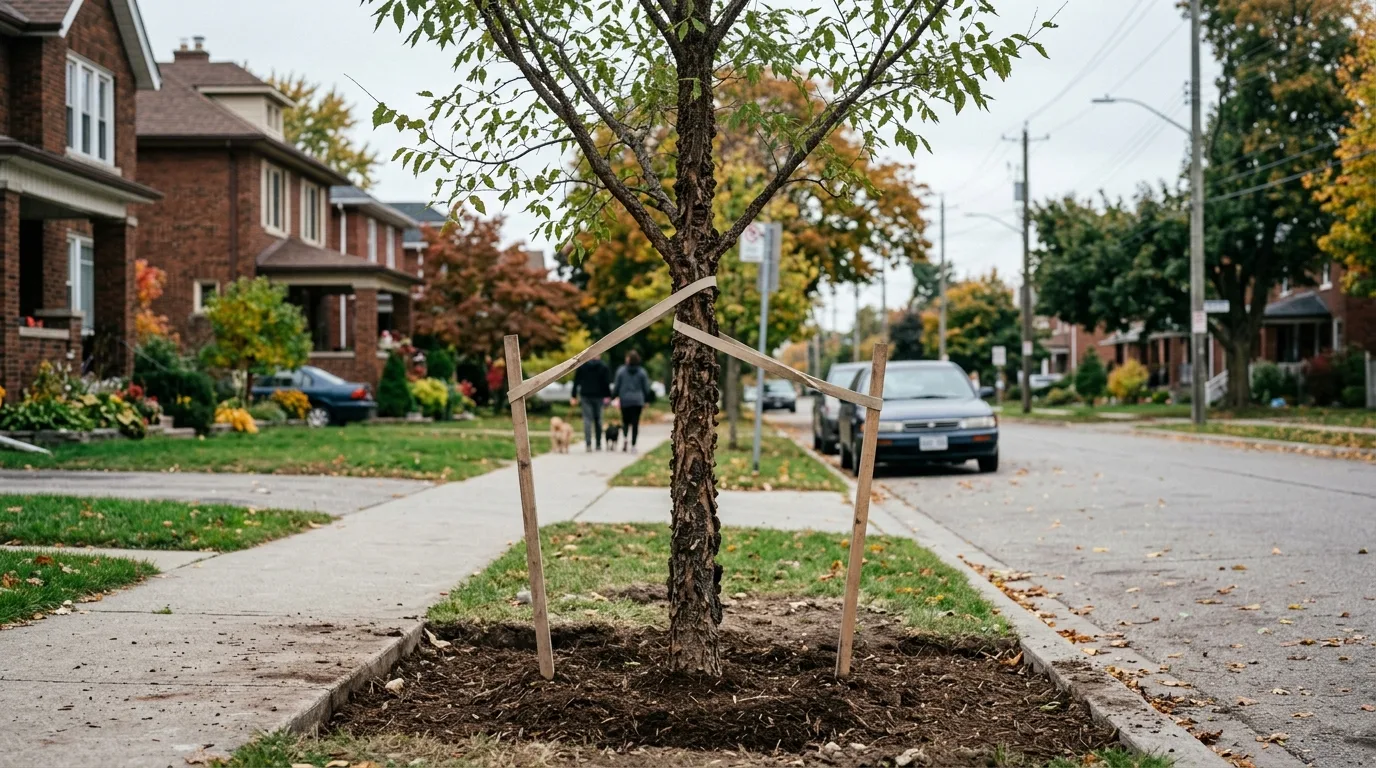
You will know it by the bark, which is the most distinctive thing about it. Corky, warty ridges, with irregular knobs and ripples running up the trunk like the tree has grown over something. Nothing else here looks like that.
Leaves are simple, alternate, toothed, with a long tapering tip and a lopsided base, where one side of the leaf meets the stem lower than the other. Fruit is a small dark berry that persists into winter and feeds birds. Cedar waxwings love them.
Why the county planted it
Hackberry does the things Essex County needs a street tree to do.
- It handles clay. Our soil defeats a lot of nursery stock and hackberry does not mind it.
- It handles drought and heat, which matters in a county that gets the hottest summers in Canada.
- It tolerates road salt better than most, which matters on a boulevard.
- It tolerates compaction and poor rooting volume, which is what a boulevard actually is.
- It is native, which after the ash experience became a priority.
That last point is worth dwelling on. Planting a single species everywhere is exactly how a county loses its whole canopy in ten years. Hackberry is part of a deliberately more mixed replanting.
The two things people call about
Nipple gall
Small raised bumps all over the underside of the leaves, sometimes hundreds on a single leaf, each with a corresponding dimple on top. Looks like a disease, and homeowners find it alarming.
It is caused by a tiny insect called a psyllid, a jumping plant louse, that lays eggs in the developing leaf, and the leaf grows a chamber around the larva. It is cosmetic. It does not harm the tree, it does not spread to other species, and it does not need treating. Spraying is a waste of money and does not work anyway, because the insect is inside the leaf tissue.
The psyllids do come indoors in autumn through window screens, which is genuinely annoying and also harmless.
Witches' broom
Dense clusters of short twiggy growth at the branch tips, most visible in winter when the leaves are off. Looks like the tree is deformed.
Caused by a combination of a mite and a powdery mildew. Also cosmetic. It makes the crown look untidy and can be pruned out if it bothers you, but it does not threaten the tree's health or structure.
Both of these are more common on hackberry in warm humid summers, which describes every Windsor July.
What actually matters with hackberry
Structure, when it is young
Hackberry tends to grow multiple competing leaders and to hold branches at narrow angles if nobody intervenes. Structural pruning in the first ten to fifteen years, selecting a single leader, spacing the scaffold branches, removing crossing limbs, is what determines whether it is a good tree at forty years or a liability.
This is the highest-value pruning anyone can do and almost nobody does it, because a young tree does not look like it needs attention. A well-structured young hackberry is a tree you never have to remove. A neglected one becomes a co-dominant mess like every failing silver maple in this city.
If you have a boulevard hackberry, remember it is the municipality's tree, so you cannot prune it and neither can we. If it is on your own property, this is worth doing. See tree trimming and pruning.
Roots and surfaces
Hackberry roots can surface in clay soil the way most trees here do, though less aggressively than silver maple. Give it distance from a driveway if you are planting.
Fruit drop
Small berries in autumn. Considerably less trouble than mulberry or walnut.
Should you plant one?
If you are replacing a tree in Windsor-Essex, hackberry is a reasonable pick, particularly for a hot exposed spot with bad soil where a maple would struggle.
We would also put a word in for the rest of the Carolinian list: Kentucky coffeetree, tulip tree, swamp white oak, sycamore. Essex County can grow things most of Canada cannot, and there is an argument for using that rather than planting the same three species everyone else does. More in trees of the Carolinian zone.
If you need work done
Tree Removal Windsor does structural pruning on young trees, crown work on mature ones, and removals across the county. If you are worried about lumpy leaves on a hackberry, get in touch and we will probably tell you not to spend anything.
Serving Windsor, LaSalle, Tecumseh, Amherstburg, Leamington, Kingsville, and Essex.