Windsor-Essex sits in the most tornado-active corridor in the country, and we take sustained wind off Lake St. Clair and Lake Erie with almost nothing in the way to slow it down. Flat county, big water, few windbreaks. When a system comes through here it does damage.
If a tree is down on your property right now, work through this in order. The order matters, because people usually start at step four and create problems for themselves.
1. Look for wires before you look at the tree
Any tree down near or on a power line, or that has taken a line down with it, is an electrical emergency and not a tree job. Same if a limb is resting on the service drop to your house.
Assume every downed line is live. Assume the ground near it is energized. Stay back a good ten metres and keep kids and dogs inside.
Call your electricity distributor, not us. Which one depends on where you live:
- Windsor: ENWIN
- Amherstburg, LaSalle, Tecumseh, Leamington: Essex Powerlines
- Essex, Kingsville, Harrow, Cottam, Comber, Belle River: E.L.K. Energy
- Rural Essex County: Hydro One
If you are not sure, the distributor's name is printed at the top of your electricity bill. They have to make the site safe before anyone can touch the tree, and no legitimate crew will work around a live line. We will not cut a tree off a line, and nobody reputable will.
2. Get people out of the way
If a tree is on the house, get everyone out of the rooms underneath it. If the roof is breached or the ceiling is sagging, get everyone out of the house until somebody has looked at it.
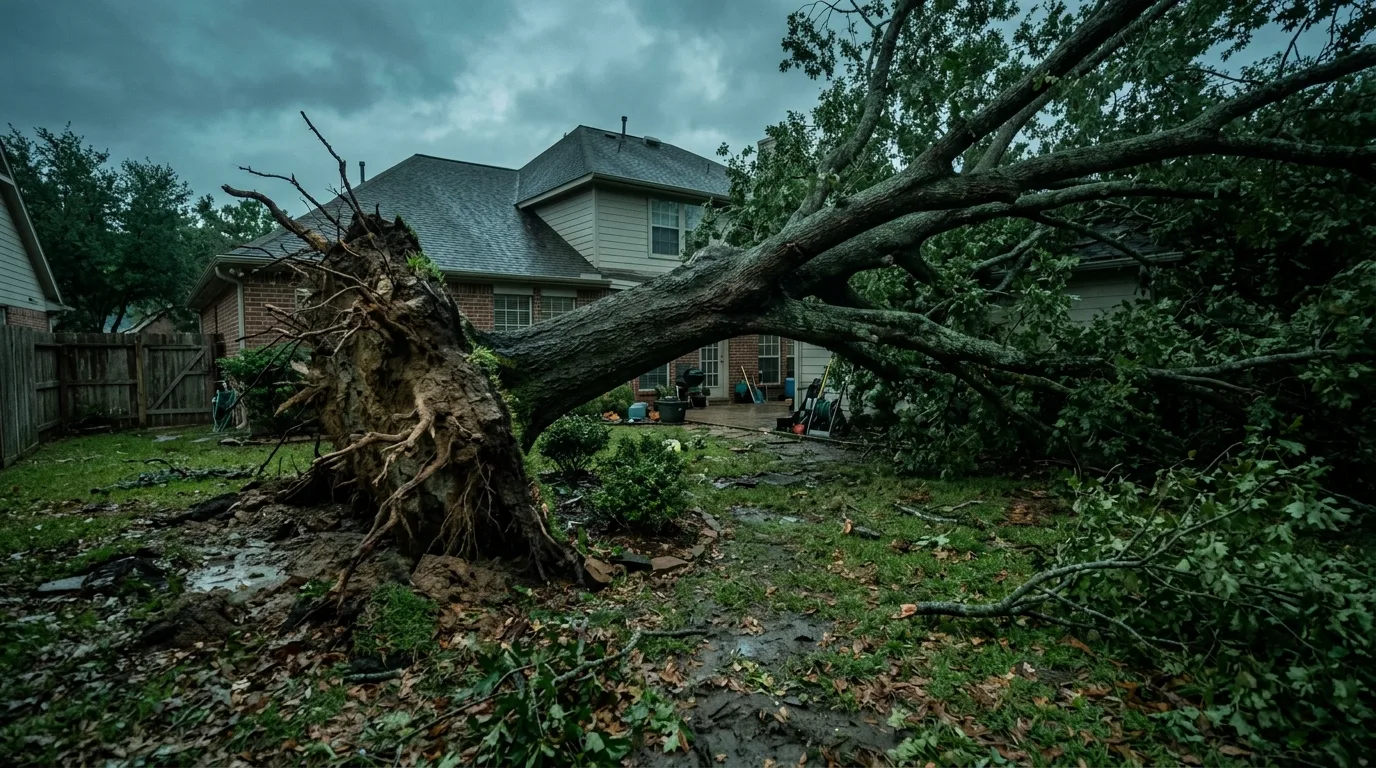
If a tree is leaning, hung up in another tree, or partly uprooted with the root plate lifted, treat the whole area under and around it as off limits. Hung-up trees are the most dangerous situation in this work and they release without warning.
Do not park under it. Do not stand under it to take photos.
3. Photograph everything before anything moves
This is the step people skip and regret.
Take wide shots showing the whole scene, then close shots of the damage, then photos of the base of the trunk and the direction of fall. Get the root plate if it is lifted, and the interior damage if there is any.
Do it before a crew arrives, because once the tree is cut into pieces the evidence of what happened is gone, and your adjuster will want to see it.
4. Call your insurer, and ask two specific questions
Not whether you are covered. Ask these:
- Is debris removal covered, and what is the sublimit on it?
- Does the policy require you to use a specific contractor or get multiple quotes?
Coverage generally follows damage. A tree on your house is usually a claim. A tree lying harmlessly in the yard usually is not. Removal costs are often capped separately from the structural repair, and the cap can be well below what a large removal actually costs. Better to know that in hour one. Full detail in does home insurance cover tree removal in Ontario.
Keep every invoice and every photo.
5. Then call a tree crew
In that order, because a crew arriving before the utility has cleared the lines cannot do anything, and a crew arriving before you have photographed the scene can cost you money on the claim.
What to look for when you are calling around after a storm
- Proof of liability insurance and WSIB clearance, in writing, before anybody climbs. Storm season brings out crews from outside the area with a truck and a chainsaw and no coverage. If they damage your house, that becomes your problem.
- A written scope. What is being removed, what is being left, whether the stump is included, whether the wood is hauled away.
- No demand for full payment in cash up front.
We are not going to pretend the wait will not be real. After a significant system every crew in the county is triaging, and we prioritize trees on houses and trees blocking access over trees lying in a backyard. If your situation is the second kind, we will be honest about when we can get there rather than saying tomorrow and not showing up.
6. Emergency tarping if the roof is open
If there is a hole in the roof and rain is coming, get it covered. Water damage over two days can exceed the original impact damage.
Some tree crews tarp and some do not, so ask. A roofer can also do it, and after a storm they are as busy as we are.
Do not go on a storm-damaged roof yourself.
What we would rather you did not do
Do not cut it yourself
Storm-damaged trees are under load in ways you cannot see. A trunk lying across a fence has tension and compression in it, and cutting the wrong side means the wood moves fast. Chainsaw injuries spike after storms in this county every single year, mostly among homeowners.
Do not hire the crew that knocked on your door
Unless they can produce insurance paperwork on the spot. More on the tells in what goes wrong with cheap tree removal.
Do not remove a tree that only lost limbs
Some of them recover fine. That is an assessment, not a decision to make in the middle of a cleanup.
The thing that prevents most of this
Most of the trees we take off houses in Windsor were identifiable as problems beforehand. Dead ash left standing since the borer went through. Silver maples with split co-dominant forks. Limbs over a roof that were dead two summers ago.
Storms do not usually take healthy trees. They take the ones that were already failing.
If you have something you have been watching, get it assessed before the next system rather than after.
Right now
Tree Removal Windsor runs emergency response across the county for trees on structures, trees blocking driveways, and hung-up or partly uprooted trees. Full liability insurance, WSIB clearance, and we document jobs so your adjuster can process them.
Serving Windsor, LaSalle, Tecumseh, Amherstburg, Leamington, Kingsville, and Essex.